
Start with the water-treatment grade
Industrial wastewater and drinking-water supply require different specifications. Confirm the intended use before choosing a physical form. In the TENORCHEM range, both powder and liquid have separate industrial and drinking-water options.
Compare the separate industrial powder, drinking-water powder and liquid PAC specifications. The ranges on those pages cover different models; agree the selected model’s Al₂O₃ guarantee, basicity and impurity limits before comparing physical forms.
Compare the work required at your plant
| Decision | Powder PAC | Liquid PAC |
|---|---|---|
| Preparation | Plan bag handling, dissolution equipment and a consistent prepared-solution concentration. | Plan liquid receiving, transfer and metering. Confirm whether the selected model needs dilution for your equipment. |
| Storage | Keep bags dry, closed and protected from humidity. | Check storage temperature and protect from freezing and direct sunlight; confirm the model’s shelf life. |
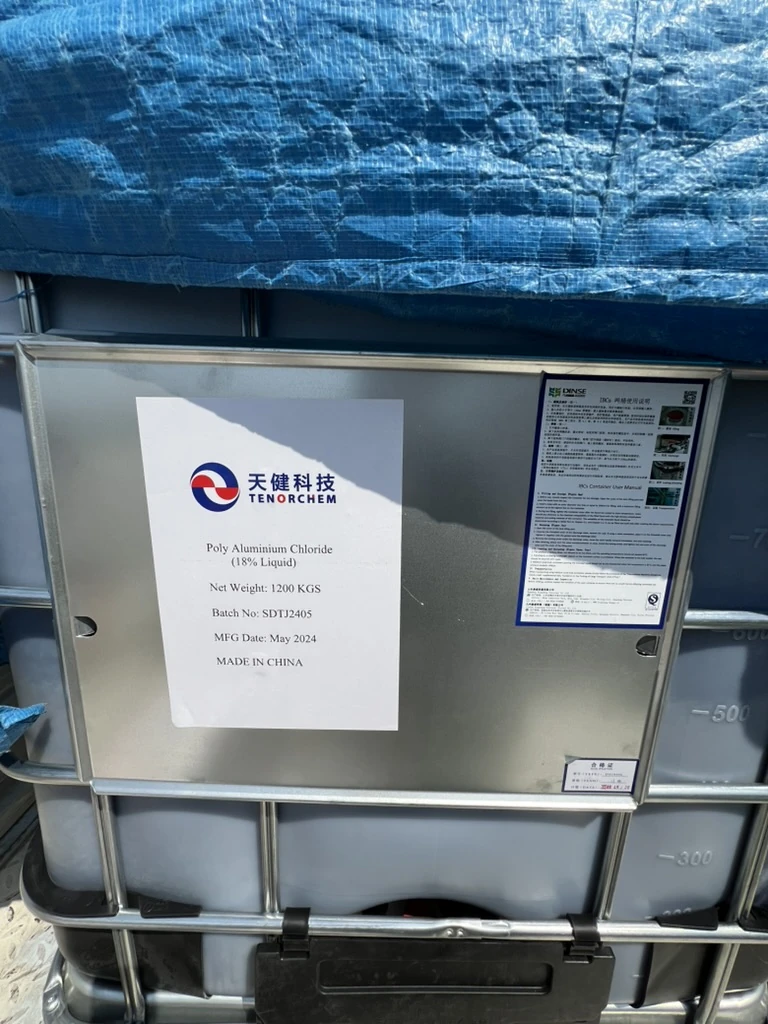
| Delivery basis | 25 kg bags in the current range. | 1,000 L IBC capacity; confirm the actual net product weight. |
| Before switching | Check preparation capacity and the proposed dosing basis. | Check tank, pump and contact-material suitability using the model’s technical and safety data. |
If you already operate a powder preparation system, compare how the proposed model behaves in that system. If you receive liquid directly, check available storage and transfer arrangements before ordering a different concentration. Ask for the model’s preparation instructions; there is no single dilution instruction for every PAC grade.
Compare content and delivery cost on the same basis
Al₂O₃ content is a useful purchasing basis, but it is not a direct measure of PAC treatment efficiency. For illustration, 1,000 kg of a product at exactly 30% Al₂O₃ contains 300 kg on that basis. A product at exactly 10% would require 3,000 kg to supply the same Al₂O₃ mass.
This arithmetic compares content only. It does not establish an equivalent dose or justify replacing one model with another. Basicity, impurity limits and the actual water-treatment results still need review. Compare the delivered product cost together with preparation work, storage and the performance established in your trial.
Check the change with a comparable trial
Use representative water and record its source, pH, turbidity or suspended solids, and the treatment target. Test candidate models under documented, comparable conditions. Record product concentration, prepared-solution concentration, dosage units, addition sequence and the measurements used to judge the result.
Keep both the current model and the proposed model identifiable in the trial record. Changing from powder to liquid does not mean the old pump setting or product-mass dosage carries over unchanged. Review the results and the plant’s metering basis before a change in bulk supply.
If you are also deciding between a coagulant and a polymer, read the PAC vs PAM treatment-role guide. That is a separate choice from selecting the physical form of PAC.
Send a brief that supports a useful comparison
- Water source, industrial or drinking-water use, and the treatment result required.
- Current PAC model, product concentration, dose with units and available trial results.
- Preparation, storage and dosing equipment; expected consumption and receiving arrangements.
- Required specification, quantity, delivery destination and packaging preference.
Ask for the proposed model’s specification, TDS, SDS and a representative COA. Agree the model and delivery weight before confirming the order.