Technical specifications
Specifications for dry APAM models. Solid content is not a purity claim; model parameters and chemical identity are confirmed against the corresponding TDS and SDS.
APAM · dry powder / crystal
| Parameter | Specification |
|---|---|
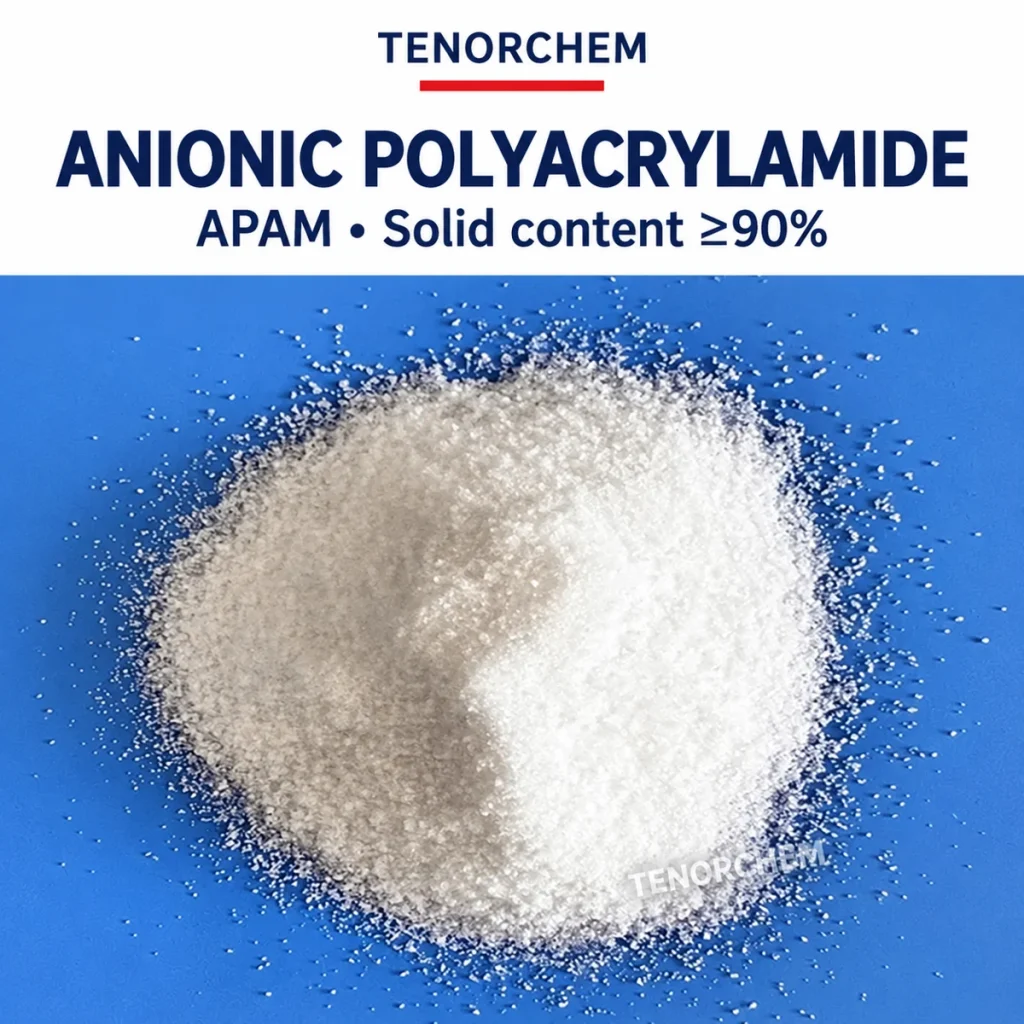
| Appearance | White / off-white powder or crystal |
| Solid content | ≥90% |
| Molecular weight | 12–30 million |
| Hydrolysis / ionicity | Hydrolysis: 10–40% |
| Insoluble deposit | ≤0.3% |
| Dissolving time | ≤60 or ≤90 min, by model |
| Residual monomer | ≤0.05% |
Dissolving time depends on the specified test conditions. Request the model’s preparation guidance and technical data sheet.
Match hydrolysis and molecular weight.
1. Describe the water or slurry, suspended solids, separation equipment and clarification or thickening target.
2. Compare molecular weight and degree of hydrolysis for the proposed APAM models. Hydrolysis is the parameter used here; the CPAM page instead lists ionicity.
3. Evaluate samples using your process conditions. Agree preparation instructions and whether the model uses the 60-minute or 90-minute dissolution limit.
Clarification and solids-separation trials
Discuss APAM evaluation for industrial wastewater, coal washing, mineral processing or tailings within the PAM range. Share the actual water or slurry and current separation programme; the ionic family and individual model should be confirmed by testing.
Packaging & storage
25 kg PE-lined kraft bags for dry PAM. Confirm the model, custom packing or labels, quantity, pallet preference and destination.
Store in a cool, dry place, protected from moisture and direct sunlight. Keep bags tightly closed and request the selected model’s preparation and handling instructions.
Sample availability, quantity and buyer-paid international courier charges are agreed before dispatch.
Model documents
Request documents for the selected model and test conditions. A representative COA supports evaluation; the supplied lot’s COA records its tested results.
Compare related options
Polyacrylamide (PAM) overview ↗
Cationic Polyacrylamide (CPAM) ↗