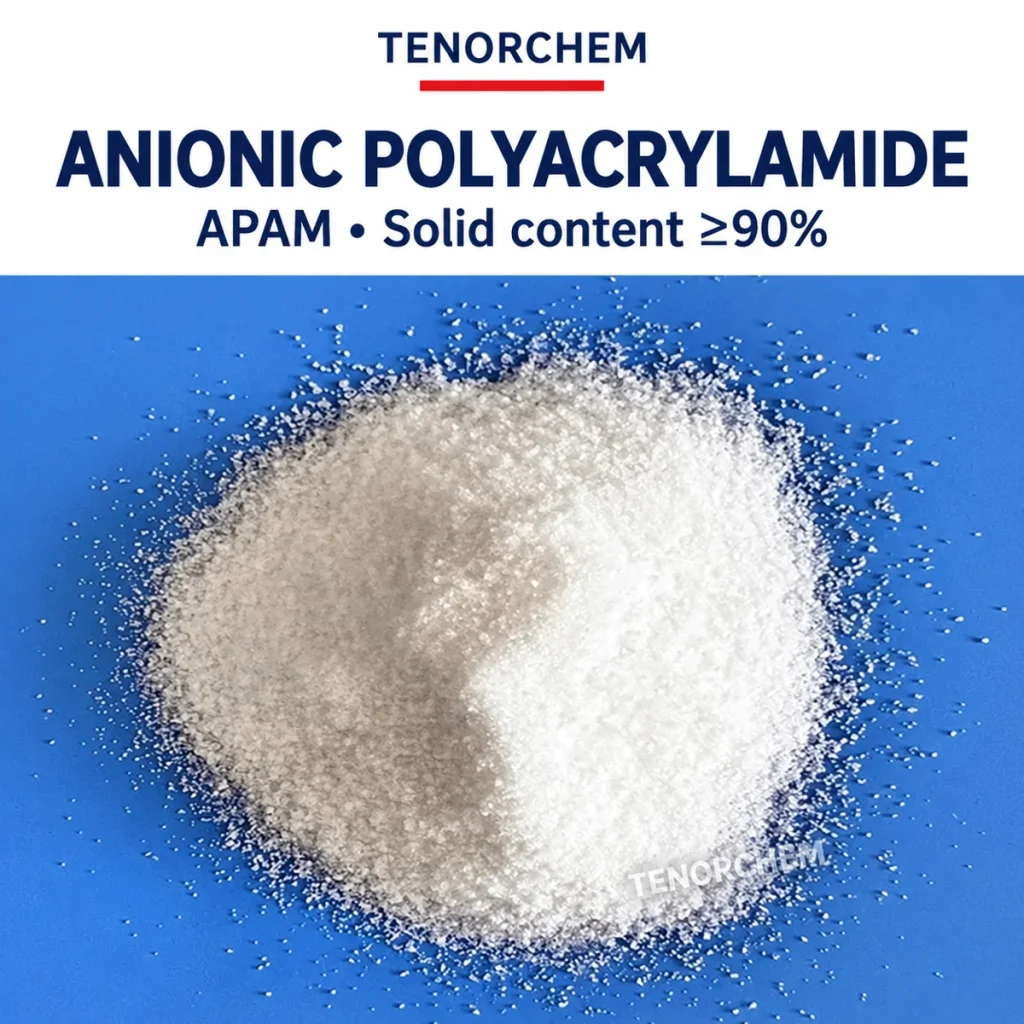
Featured product: APAM. CPAM and NPAM are selected separately by their model specifications.
PAM includes anionic polyacrylamide (APAM), cationic polyacrylamide (CPAM) and nonionic polyacrylamide (NPAM).
Annual production capacity: 20,000 tonnes. Factory capabilities ↗
Compare grades & specifications
Compare the ionic types below, then open the corresponding page for the complete dry-product specification. All three published types have solid content ≥90%.
| Parameter | APAM · anionic | CPAM · cationic | NPAM · nonionic |
|---|---|---|---|
| Molecular weight | 12–30 million | 6–15 million | Model-specific |
| Hydrolysis / ionicity | Hydrolysis: 10–40% | Ionicity: 5–95% | Hydrolysis: ≤5% |
| Dissolving time | ≤60 or ≤90 min, by model | ≤60 or ≤90 min, by model | ≤90 min |
Hydrolysis and ionicity are different model parameters. NPAM molecular weight remains model-specific; dissolution limits depend on the specified test conditions.
Anionic Polyacrylamide (APAM)
Anionic models selected by molecular weight and degree of hydrolysis.
Cationic Polyacrylamide (CPAM)
Cationic models for sludge-conditioning and dewatering trials.
Nonionic Polyacrylamide (NPAM)
Nonionic models with molecular weight confirmed individually.
Applications
Water clarification & solids separation
Polymer options for municipal and industrial wastewater, coal washing, mineral processing and tailings. Compare the relevant ionic types and models using the actual water or slurry.
Sludge conditioning & dewatering
Discuss sludge properties, the current treatment programme and dewatering equipment. CPAM offers model options for sludge conditioning; the final selection depends on evaluation.
Pulp & paper
PAM models for retention, drainage and other paper-process requirements. Share the furnish, existing treatment chemicals and performance target for model evaluation.
Oilfield & industrial separation
Models can be evaluated for oilfield wastewater and industrial solids-separation processes. Water chemistry, treatment equipment and trial results guide the selection.
How to select a PAM model
1. Describe the water or sludge, treatment equipment and objective: clarification, thickening, dewatering or another separation process.
2. Share the current polymer model, ionic type and trial results if available. Discuss molecular weight and hydrolysis or ionicity for the proposed model.
3. Evaluate samples under your process conditions, then agree the selected model, preparation method and order specification.
4. For a quotation, add the quantity, destination, packaging, pallet preference and required documents for the selected model.
Support from polymer selection to process trials
Our laboratory and technical teams help review model requirements for your water, slurry or sludge. Discuss sample testing, polymer preparation and process-trial results as the treatment programme develops.
Water-treatment field experience
TENORCHEM’s visit to an overseas customer’s wood-processing plant focused on wood-cooking wastewater treatment. View the site visit and technical exchange ↗
Packaging & supply
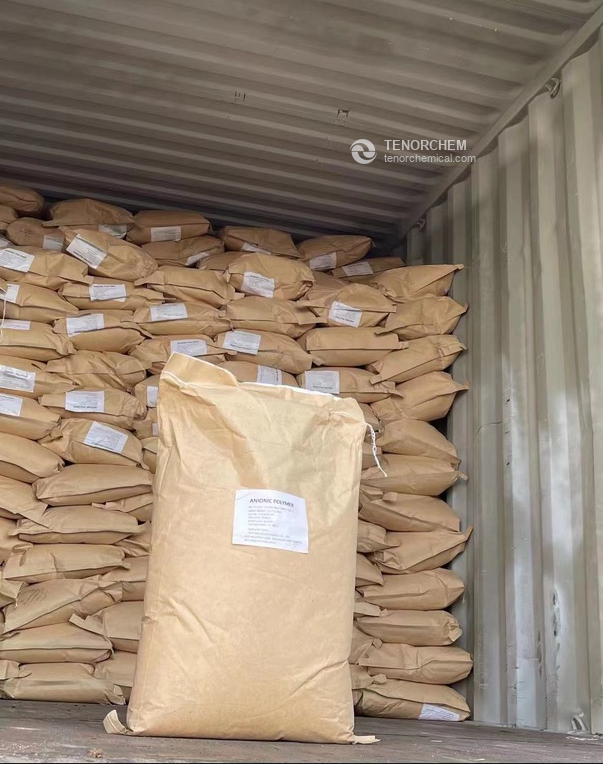
25 kg lined bags
PE-lined kraft bags for dry PAM. Custom packing and label requirements can be discussed for the order.
Sample evaluation & bulk supply
Discuss samples for the proposed model before bulk supply. Confirm quantity, pallet preference and destination for a container quotation.
Sample availability, quantity and buyer-paid international courier charges are agreed before dispatch.
Storage
Store in a cool, dry place, protected from moisture and direct sunlight. Keep bags tightly closed and request the selected model’s preparation and handling instructions.
Common questions
Which PAM type should I choose?
Start with your process, water or sludge properties and treatment objective. Ionic type and molecular weight are selection parameters; a sample trial is needed to compare the relevant models.
Is ≥90% solid content the same as purity?
No. It describes solid content for the APAM, CPAM and NPAM specifications shown here. It is not a polymer-purity claim.
What molecular weight is available for NPAM?
NPAM molecular weight is confirmed for the specific model. Share the application and required performance so the corresponding technical data can be provided.
Are hydrolysis and ionicity interchangeable?
The APAM and NPAM models are described here by degree of hydrolysis, while the CPAM range is described by ionicity. Use the parameter specified for your selected model.
Documents & inquiry
Technical data sheet (TDS)
Model parameters, test conditions and preparation guidance.
Safety data sheet (SDS)
Handling, storage and chemical identity for the specified product.
Certificate of analysis (COA)
A representative COA supports model evaluation; a batch COA records the supplied lot’s results.
For a quotation, include the selected model, application, quantity, packaging and destination.
Related products & guides
PAC · inorganic coagulant grades
PolyDADMAC · liquid cationic polymer
APAM, CPAM or NPAM: choosing a PAM model — Compare anionic, cationic and nonionic PAM. Build a sample shortlist, read model parameters and record a useful clarification or sludge-dewatering trial.
PAC vs PAM: choosing chemicals for water treatment — Understand PAC coagulants and PAM flocculants, compare selection parameters and prepare the water or sludge information needed for a sample trial.
25 kg bags vs big bags: choosing chemical packaging — Compare 25 kg bags and 1,000 kg big bags for chemical supply, including receiving equipment, storage, pallets, labels and product-specific availability.