
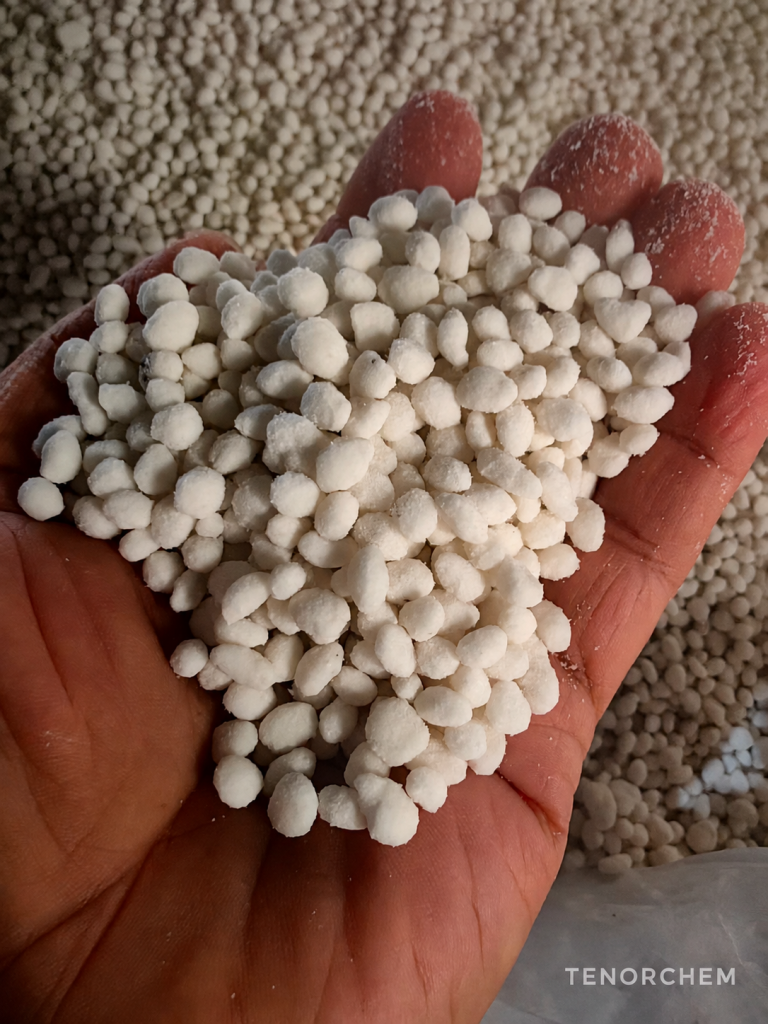
Granular deicing salt · actual product photograph. Particle size and formulation are confirmed for the selected model.
Organic–inorganic composite deicing salt
Also known as snow-melting agents, ice-melt compounds or deicing compounds. Composition depends on the selected formulation.
Designed for winter road maintenance.
Protective additives
The composite formulation includes protective ingredients designed to reduce the impact of conventional deicing salts on metal, concrete and roadside surroundings. Agree material compatibility and corrosion criteria for the intended site.
Fast melting & controlled use
Formulated for rapid snow melting at economical application rates. Early treatment and a dose matched to the weather support effective use.
Free-flowing for spreading
Suitable for manual broadcasting or mechanical spreading. Select the product form and particle requirements for your equipment.
Quality standard reference
GB/T 23851-2017 is China’s national standard for deicing agents. The tables below summarize its requirements for solid deicers as a reference, not a declaration that every TENORCHEM formulation meets these limits. The selected model’s specification and supporting test reports are agreed before supply.
GB/T 23851-2017 · performance & physical properties
| Parameter | Standard reference requirement |
|---|---|
| Solid dissolution rate | ≥6.0 g/min |
| Relative snow and ice melting capacity | ≥90% |
| Freezing point at use concentration | As agreed between supplier and buyer |
| pH | 6.0–10.0 |
| Carbon steel corrosion rate | ≤0.11 mm/year |
| Road-surface friction attenuation | ≤10% |
| Relative plant-seed injury rate | ≤50% |
| Water content (solid product) | ≤5% |
| Water-insoluble matter | ≤5% |
Apply the test methods in GB/T 23851-2017. Relative melting capacity is compared with sodium chloride for Type I and calcium chloride dihydrate for Type II. The solid dissolution test measures dissolution in water; it is not a snow-melting rate. Concrete corrosion is not an item in the 2017 standard table.
Trace-element reference limits · solid product, dry basis
| Parameter | Standard reference limit |
|---|---|
| Mercury (Hg) | ≤1 mg/kg |
| Cadmium (Cd) | ≤5 mg/kg |
| Chromium (Cr) | ≤15 mg/kg |
| Lead (Pb) | ≤25 mg/kg |
| Arsenic (As) | ≤5 mg/kg |
These limits are calculated on the dry mass of the solid deicer. They are standard limits, not measured batch results; request the selected model’s supporting test report.
Classification used by the standard
| Classification | Standard definition |
|---|---|
| Type I | Freezing point of the solution at use concentration: −15°C to −10°C |
| Type II | Freezing point of the solution at use concentration: below −15°C |
| Non-chloride category | Chloride (as Cl⁻): ≤1.0% |
| Chloride category | Chloride (as Cl⁻): >1.0% |
These definitions classify the formulation; the chloride threshold is not a universal maximum. Confirm the type, chloride category and use concentration for the selected model.
GB/T 23851-2017 · official national-standard record ↗
GB/T 23851-2017 · official full text (Chinese) ↗
Applications
Roads & highways
For snow and ice control on ordinary roads and highways. Match the formulation and spreading programme to the pavement and winter conditions.
Ports & parking areas
For vehicle access routes, port yards and parking areas requiring winter maintenance. Include surface and nearby metalwork requirements in the product selection.
Walkways & public areas
For winter-maintenance programmes on pedestrian routes and public areas. Select the formulation for the paving material, spreading equipment and nearby landscaped areas.
Airport projects
The product range includes airport-related snow-clearing applications. Confirm the exact area, applicable procurement specification and operator acceptance before selecting a formulation.
Application guidance
Choose the formulation for the site, expected temperatures and material-compatibility requirements before setting the spreading programme.
1. Apply by hand or mechanical spreader at the start of snowfall, or around 1–2 hours before expected road icing.
2. Use the reference application rates as a starting point. Adjust for pavement temperature, precipitation, traffic and the selected formulation.
3. Coordinate repeat application with snow-clearing operations. Confirm surface compatibility, runoff requirements and the seasonal delivery plan.
Reference application rates
| Air temperature | Anti-icing · g/m² | Snow melting · g/m² |
|---|---|---|
| 0 to −5°C | 30 | 50 |
| −5 to −10°C | 50 | 80 |
| −10 to −15°C | 80 | 120 |
Reference rates published on TENORCHEM’s Chinese website. Adjust to actual pavement temperature, precipitation, traffic and model guidance. Confirm treatment rates separately for conditions outside these temperature bands. Source: TENORCHEM Chinese product information.
TENORCHEM Chinese application guidance ↗
Packaging & supply
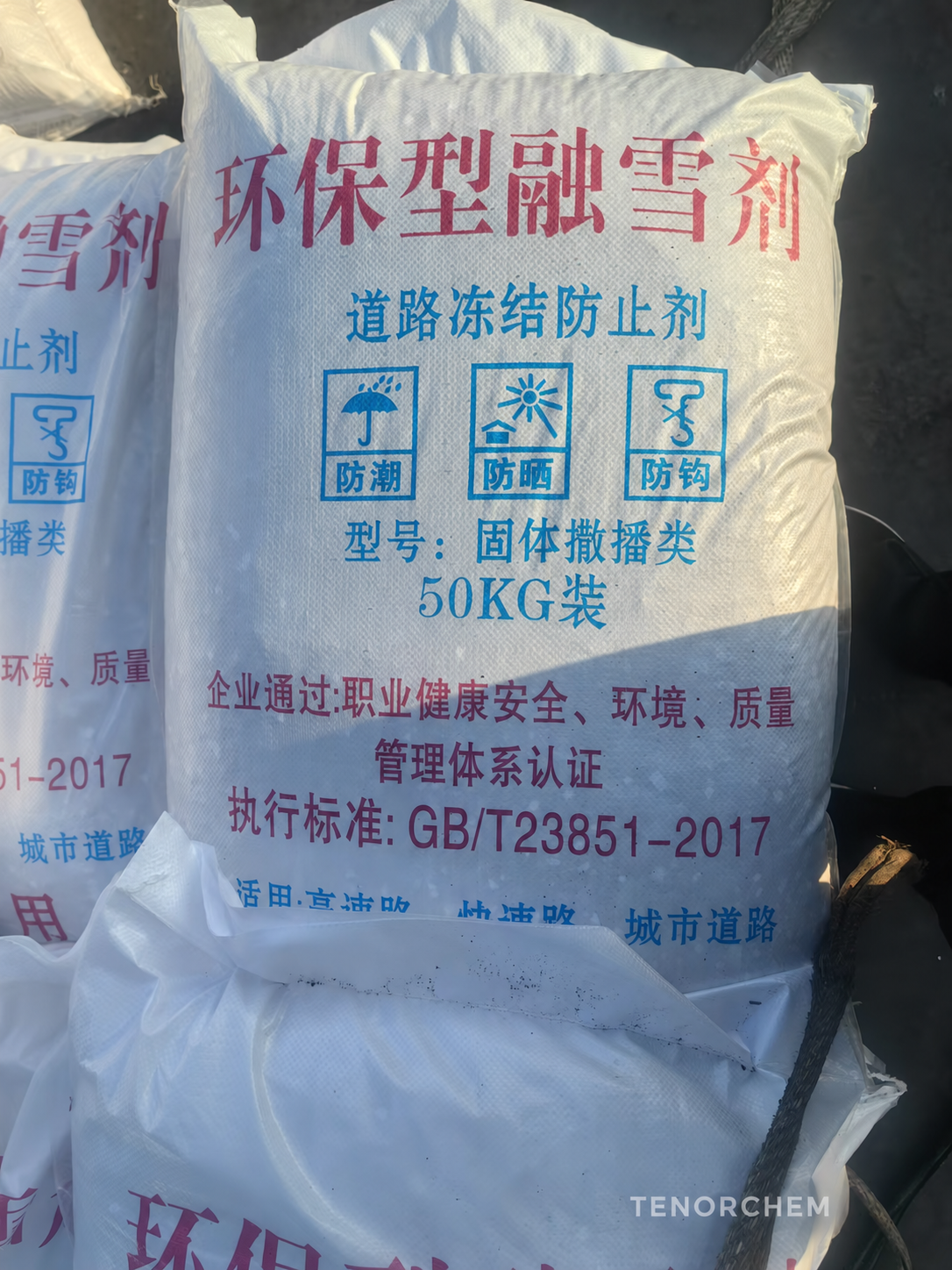
25 kg & 50 kg bags
25 kg PP woven bags with PE inner liners. The photograph shows a 50 kg woven-bag packing example. Confirm bag material, net weight and label artwork for your order.
Big bags & pallet loading
1 tonne big bags, palletized loading and other packing arrangements can be discussed for the order and destination.
Sample availability, quantity and buyer-paid international courier charges are agreed before dispatch.
Storage
The product is strongly hygroscopic. Store in a dry, ventilated place, protected from direct sun and rain. Keep bags tightly sealed before use and reseal opened bags to limit moisture uptake.
Common questions
What makes this an environmentally focused deicer?
The organic–inorganic salt blend includes protective additives designed to reduce corrosion and the impact on roads and surrounding vegetation compared with conventional deicers. Suitability depends on formulation, dosage and site conditions; request the relevant technical and test information.
How much should I spread?
The reference table distinguishes anti-icing from snow-melting rates. Start from the temperature band and intended purpose, then adjust for pavement temperature, precipitation, traffic and the selected model.
Can every formulation be used at −30°C?
The Chinese product information gives −30°C as a low-temperature reference. Confirm the selected formulation and its performance data for the intended conditions; the published dosage table covers only 0°C to −15°C.
Is this the same as calcium chloride?
No. Calcium chloride is a specific chemical, while this product is a composite salt formulation with protective additives. Composition and supporting documents are agreed for the selected model.
Are these guaranteed specifications for every formulation?
No. The tables summarize GB/T 23851-2017 as a standard reference. Confirm the selected formulation, classification, use concentration and agreed specification with its TDS and supporting test reports. A batch COA provides results for the supplied lot.
Documents & inquiry
Technical data sheet (TDS)
Model parameters, test conditions and preparation guidance.
Safety data sheet (SDS)
Handling, storage and chemical identity for the specified product.
Certificate of analysis (COA)
A representative COA supports model evaluation; a batch COA records the supplied lot’s results.
For a quotation, include the selected model, application, quantity, packaging and destination.
Related products & guides
Choosing deicing salt for your site — Choose a deicing salt formulation by site, winter conditions, spreading equipment and test evidence. Prepare a practical trial and seasonal supply brief.
25 kg bags vs big bags: choosing chemical packaging — Compare 25 kg bags and 1,000 kg big bags for chemical supply, including receiving equipment, storage, pallets, labels and product-specific availability.