
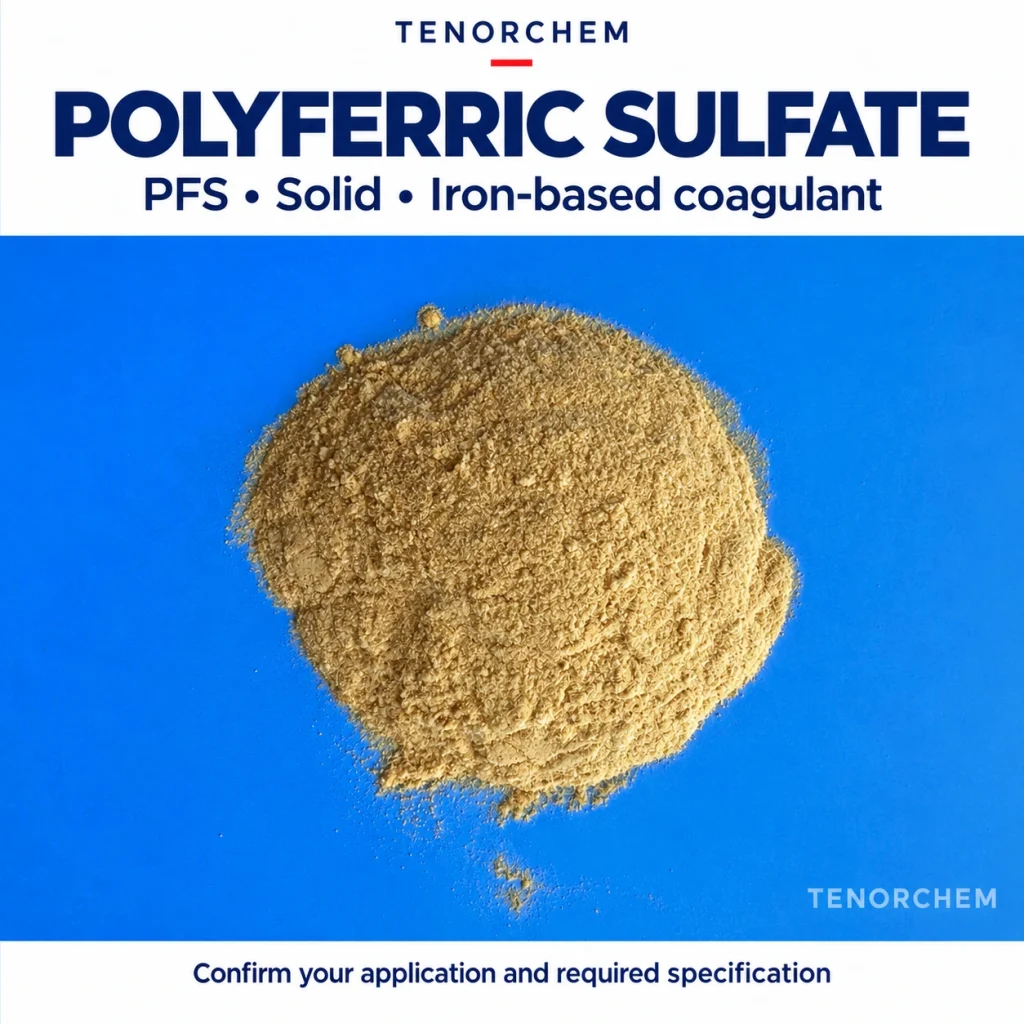
Solid polyferric sulfate (PFS) · product sample photograph.
Polyferric sulfate · solid coagulant
Also known as polymeric ferric sulfate, polyferric sulphate or PFS.
Annual production capacity: 10,000 tonnes. Factory capabilities ↗
Solid PFS standard reference
Use GB/T 14591-2016 as the technical reference when discussing a PFS specification. The standard distinguishes total iron from reducing substances expressed as Fe²⁺. Agree the selected product grade and complete limits before ordering.
Solid PFS · standard reference
| Parameter | First grade · standard reference | Qualified grade · standard reference |
|---|---|---|
| Total iron, as Fe | ≥19.5% | ≥19.5% |
| Reducing substances, as Fe²⁺ | ≤0.15% | ≤0.15% |
| Basicity | 8.0–16.0% | 5.0–20.0% |
| pH · 10 g/L aqueous solution | 1.5–3.0 | 1.5–3.0 |
| Insoluble matter | ≤0.4% | ≤0.6% |
Selected standard limits for comparison, not batch analysis or a blanket conformity declaration. Request the model’s full TDS and COA, including trace-element limits.
GB/T 14591-2016 · official standard record ↗
Applications
Industrial wastewater
Evaluate coagulation and clarification for textile, dyeing, pulp and paper, petrochemical and food-processing wastewater. Compare the models using the actual effluent and treatment target.
Municipal treatment
Discuss the treatment stage, influent characteristics and solids-removal target to select an appropriate PFS model.
Mineral & process-water clarification
An option for separating solids from process water. Compare performance through jar tests and assess the resulting sludge.
Oilfield water treatment
PFS can be evaluated for clarification of oilfield wastewater. Include suspended-solids and oil-related treatment targets, and assess the resulting sludge during the trial.
Evaluate PFS with your actual water
Use the reference table to define the parameters to discuss. Select the product model through its TDS and treatment trials; the reference limits do not replace an agreed order specification.
1. Share the water analysis, treatment objective, process pH and current coagulant.
2. Specify the required solid grade, iron content, basicity and impurity limits; use consistent test methods for comparison.
3. Evaluate dosage, settling behaviour and sludge performance through sample trials before a bulk order.
Compare coagulants with your water
Our laboratory and technical teams support product testing for specific treatment requirements. Discuss PFS trial results alongside the current coagulant, settling behaviour and sludge-handling needs.
Packaging & supply
25 kg lined bags
Solid PFS in woven bags with a PE inner liner. Keep packaging sealed and protected from moisture.
Export arrangements
Confirm order quantity, pallet preference, destination and any custom labelling when requesting a quotation.
Sample availability, quantity and buyer-paid international courier charges are agreed before dispatch.
Storage
Keep packaging closed in a cool, dry and well-ventilated place. Follow the selected product’s SDS for storage and handling.
Common questions
Are total iron and Fe²⁺ the same specification?
No. Total iron is the main content parameter. Reducing substances, expressed as Fe²⁺, are a separate controlled parameter in GB/T 14591-2016.
How should I compare PFS with PAC?
Compare the selected models using the actual water and treatment conditions. Dosage, settling, sludge production and treated-water quality should be evaluated together.
Does the reference table replace a product COA?
No. The table is a standard reference. The selected model’s TDS defines its agreed specification, and its batch COA records the supplied lot’s results.
Documents & inquiry
Technical data sheet (TDS)
Model parameters, test conditions and preparation guidance.
Safety data sheet (SDS)
Handling, storage and chemical identity for the specified product.
Certificate of analysis (COA)
A representative COA supports model evaluation; a batch COA records the supplied lot’s results.
For a quotation, include the selected model, application, quantity, packaging and destination.
Related products & guides
PAC · compare coagulant options
PAM · flocculation and sludge treatment
Aluminium sulfate · solid grades
Choosing PFS for wastewater treatment — Select solid polyferric sulfate using water analysis, clear specification terms and a comparable treatment trial. Prepare a PFS inquiry and compare with PAC.
PAC vs PAM: choosing chemicals for water treatment — Understand PAC coagulants and PAM flocculants, compare selection parameters and prepare the water or sludge information needed for a sample trial.