
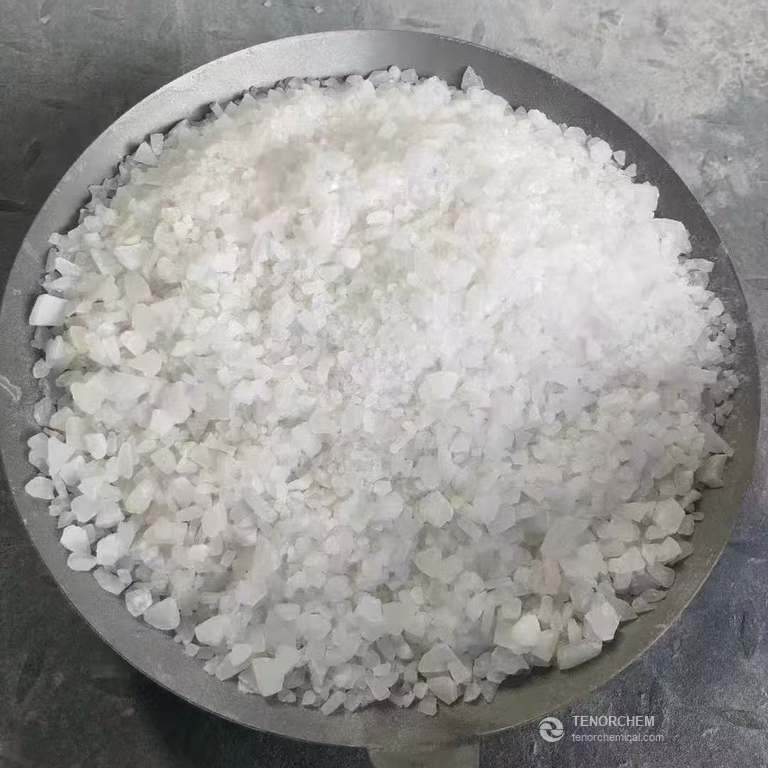
Aluminium sulfate · actual product photograph.
Aluminium sulfate · solid coagulant
Also known as aluminum sulfate or aluminium sulphate. Content is reported as Al₂O₃.
Technical specifications
These specifications describe two solid-product grades. Al₂O₃ is the reporting basis for alumina content; it is not the percentage of aluminium sulfate purity.
Compare solid grades
| Parameter | Iron-free grade | Iron-containing grade |
|---|---|---|
| Appearance | White powder / granules | Powder / granules |
| Alumina, as Al₂O₃ | ≥16.0% | ≥15.6% |
| Iron, as Fe | ≤0.2% | ≤1.0% |
| Water-insoluble matter | ≤0.1% | ≤1.2% |
| pH · 1% aqueous solution | ≥3.0 | ≥3.0 |
“Iron-free” is the commercial grade name, not a claim of zero iron. Use the stated iron limit and agreed order specification.
Trace-element limits
| Parameter | Iron-free grade | Iron-containing grade |
|---|---|---|
| Cadmium, Cd | ≤0.0002% | ≤0.003% |
| Lead, Pb | ≤0.0006% | ≤0.005% |
| Arsenic, As | ≤0.0002% | ≤0.001% |
| Chromium, Cr | ≤0.0005% | ≤0.005% |
| Mercury, Hg | ≤0.00002% | ≤0.0001% |
Mass fractions. Discuss any additional limits or destination-specific requirements when selecting the grade.
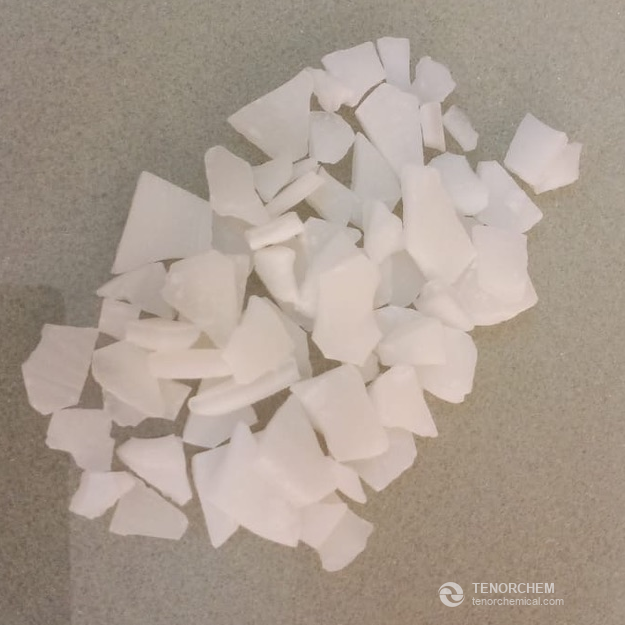
Product appearance
Applications
Water clarification
An inorganic coagulant for suspended-solids removal in water-treatment processes. Select the grade and dosage through trials using the actual water.
Pulp & paper
For paper sizing and other wet-end processes. Where colour or whiteness matters, compare the stated iron and insoluble-matter limits alongside product form and mill trial results.
Textiles & chemical processing
For textile and dyeing processes and other industrial uses of aluminium salts. Review colour sensitivity, impurity limits, dissolution and compatibility with the formulation.
Choose the grade for your process
Start with the iron and insoluble-matter limits your process can accept, then compare the two grade specifications above.
1. Identify the application and required Al₂O₃, iron and insoluble-matter limits.
2. Choose powder or granules and provide any particle-size or dissolution requirements.
3. Agree the product grade, test methods and packing after reviewing the TDS and representative COA.
Review the grade for your process
Our technical team can review your application and analytical requirements, supported by the company’s laboratories. Discuss iron, insoluble matter and trial results when selecting the grade.
Packaging & supply
25 kg & 50 kg bags
Woven bags with an inner liner. Confirm net weight, labelling and moisture protection for the order.
Custom packing
Discuss big bags, pallet arrangements and container loading with the required quantity and destination.
Sample availability, quantity and buyer-paid international courier charges are agreed before dispatch.
Storage
Keep packaging closed in a cool, dry and well-ventilated place. Follow the selected product’s SDS for storage and handling.
Common questions
What does “iron-free” mean?
It identifies the commercial grade. The published limit is Fe ≤0.2%; it does not mean the product contains no iron.
Is Al₂O₃ content the product purity?
No. It is the alumina-equivalent reporting basis used in the specification. Compare products on the same basis.
Can I request a different particle size?
Yes. Include the preferred powder or granular form and particle-size requirement in your inquiry so availability can be confirmed.
Documents & inquiry
Technical data sheet (TDS)
Model parameters, test conditions and preparation guidance.
Safety data sheet (SDS)
Handling, storage and chemical identity for the specified product.
Certificate of analysis (COA)
A representative COA supports model evaluation; a batch COA records the supplied lot’s results.
For a quotation, include the selected model, application, quantity, packaging and destination.
Related products & guides
PAC · aluminium-based coagulants
Choosing an aluminium sulfate grade — Choose an aluminium sulfate grade for water treatment or process use. Compare iron limits, product form and trial results, then prepare a clear purchasing brief.
25 kg bags vs big bags: choosing chemical packaging — Compare 25 kg bags and 1,000 kg big bags for chemical supply, including receiving equipment, storage, pallets, labels and product-specific availability.